Monday, April 8, 2019

The Appalachian Dialect


When someone asks if there are dialects of English in North America, an American may be compelled to answer, "There's a northern dialect and a southern one," but in truth there are actually a plethora of dialects and accents, many of which are secluded to a particular region. The Appalachian Dialect is among those. A rather loose term, it can span across the Appalachian Mountain Range, but some scholars may argue that each state has its own brand of southern style, as the case may be for West Virginia. For the sake of this post, the Appalachian Dialect will act as an umbrella term.

 What Is It and How Does it Work?

It’s a set of speech patterns native to the Appalachian Mountains, having evolved over the length of centuries. Much of the literature surrounding the region has rural themes, coal mining being one of the biggest. In Lee Howard’s poem “The Last Unmined Vein,” the sentence structure can be seen. Take for example these lines: “A pick and shovel…was all that was took/ and didn’t hurt nothing / and kept a fire real good / and that’s it / but that ain’t what they got in mind…” Here, the reader can see the unusual syntax through “kept a fire real good,” meaning kept it alive and burning. Notice, too, the use of “took” instead of taken and “nothing” instead of “anything.” “Ain’t” is also a common auxiliary verb in this poem, as can be seen in “that ain’t” instead of “that is not.”

Some other examples of words and phrases include: “allers” for “always,” “ax” for “ask,” “sarce” for “sauce,” and “widder” for “widow.” Other common conventions includes the contractions of words like in “s’pose” for “suppose,” “nat’ral” for “natural,” and “’spect” for “expect.”


Common Examples of the Appalachian Dialect


Such language can be found in a clever translation Lewis Carroll’s Alice in Wonderland into Appalachian English. Heavy linguistic changes gave Alice a twang unlike ever before. This translation is especially interesting to analyze since it encompasses the dialect in its rawest form. Take this excerpt of dialogue from the Cheshire cat as an example: “Up the crick,” the Bobcat says, wavin hits right paw roun…” The first thing a reader may notice is the use of eye-dialect to get the accent across, meaning that the words are being spelled as they’re sounded out. Notice the word “crick” substituted for “creek.” Even “his” has a “t” added to it in “hits paws,” signifying pronunciation.

Endings of words have been dropped as well in “wavin” for “waving” and “roun” for “round” or “around.” The dropping of “-g” in endings is quite common. The addition of “-ed” on past-tense verbs such as “knowed” instead of “knew” and “telled” instead of “told,” is also a common grammatical feature.

The Stigma

A negative stigma surrounds the Appalachian Dialect. Some may call it the "hillbilly" language. That is, people from other regions assume that because they speak this way they must be uneducated. This may be due to the idea of a “standard” way to speak English. In school, students are taught one way to speak, and other dialects are shunned as improper. However, the stereotype of the hillbilly is an old one, going as far back as the nineteenth century and possibly further. This can be blamed partly on its appearances in pop culture as well as literature throughout the years as a joke. Michael Ellis explores this theory in detail, discussing how the use of the dialect was used as a sign of stupidity, and was thus meant to not be taken seriously. It’s also been grouped in with other southern dialects, and lasting tensions since the Civil War could mean that this stereotype was implemented as a way of the Union exerting its authority, not to the extent of propaganda, but somewhat similar.

In any case, one’s dialect should not be the defining factor of him or her as a person. A dialect can be a sign of heritage or even culture, something that ties them to the region they hail from. Though the Appalachian Dialect has this stigma, it is still a dialect spoken today and should be respected as such.


A Negro Love Song: The African American Dialect in English

"A Negro Love Song" by Paul Laurence Dunbar is an example of the African-American English dialect, also known as African-American Vernacular English. Dunbar, a writer in the late 19th and early 20th centuries, was known for using the African-American English dialect in his poems and songs. These were called "negro ballads," a term also associated with minstrel songs, which used mispronunciations and misspellings to imitate African-American speech. These forms were performed with racist blackface and were meant to make fun of AAE. While minstrel songs were a form of degradation, negro songs such as Dunbar's were meant to be authentic songs that accurately portrayed African-American speech in a non-mortifying way.

Dunbar was born and raised in the North after the end of the American Civil War, but he wrote Southern poetry that centered on things like lingering racial tension. His dialect poetry was meant to imitate negro spirituals and songs during the antebellum period, or the period before and during the Civil War. At the time, the African-American dialect was associated with the minstrels and coon songs, which played on the stereotypes of African-American people rather than provide an authentic view of the dialect and the people who spoke it. Although Dunbar's poetry was meant as a tribute to AAE, many saw it, too, as degrading. Even with Dunbar's good intentions, many upper and middle class African-Americans felt that the dialect was associated with slavery before the Civil War.

Dunbar's "A Negro Love Song" several elements common to the African-American English dialect. Line 3 shows the dropping of the final consonant with, "Hel' huh han' an' sque'z it tight,". Here, we see almost every word differs from Standard English. The 'd' is dropped in "held," "hand," and "and," and the "e" and last "e" is missing in "squeeze." Another interesting thing to note is how "her" is spelled. Dunbar uses "huh" to demonstrate how AAE speakers turn the "r" sound into an "h" sound, as in "rider" turns to "ridah," for example. It is also interesting to note line 9, "Hyeahd de win' blow thoo de pine," where in "the," the "th" is replaced by "d," and the "r" sound is left out in "through." The word, "heard" is pronounced like "hyeahd," again with the "r" being left out.

There is an argument that it is important to present AAE in schools and that children should be educated in its history. As with other North American non-standard dialects, such as Southern or New England English, it is not something that is a "lower" form of English. Rather, it is an important part of American history, as well as a dialect that many people speak daily. People need to stop seeing African-American English speakers as "less intelligent" or "less likely to be successful." There is nothing wrong with speaking in a way that is different than the "standard" way of speaking. When really reflected upon, there is no such thing as a spoken standard. Standard English is only standard when writing, but there are many varieties of spoken English, and one way of speaking is not better than another.

Image Credit.

Sunday, April 7, 2019

African American Vernacular Dialect as a Social and Political Statement

The use of dialect in literature provides not only a reflection of realistic character speech patterns, but also an opportunity for social and political commentary within a text. In short fiction, such as Charles Chesnutt’s “Po’ Sandy” (1888), the use of African American Vernacular English (AAVE) in this seemingly-simple Conjure Tale adds an element of realism and also the opportunity for the reader to adopt a racialized perspective on an American Gothic tale, utilizing the dialectic language to provide commentary on social and political issues. African American Vernacular English (AAVE), or the distinct African-American dialect of English, is a language distinct in its grammar and vocabulary, often racially discriminated-against and dismissed as “slang” or a degradation of Standard English, which it is clearly and completely not. AAVE, with its own rules and structure, serves as a complete language in its own right. The below chart shows a gradient from the least-to-most expressions of AAVE in literature, with "Po' Sandy" ranking with a high expression of true AAVE, with the use of both AAVE phonological forms and AAVE grammatical forms.


 Chesnutt, in his short stories, utilizes and normalizes AAVE in his storytelling, promoting understanding and acceptance of the dialect in popular literature.
The short story involves the Marambo family and their slave Sandy, who is transformed into a tree by his lover to stop the Marambo family from sending Sandy away to labor for their grown-up children in their own households. The story, told in a frame-narrative, features a narrator who is a black former slave in the Postbellum south (Julius) who is recounting stories of the pre-Civil War plantation to the new owners, a white Northern couple. Told by Julius and in his Southern African-American Vernacular English, the short stories serve to provide a kind of moralistic tale, to ingratiate hoodoo and African-American folktales with the American Gothic tradition, and to serve a purpose for Julius within the narrative of his frame: for example, “Po’ Sandy” serves Julius by encouraging the new owners to not destroy an old school house on the property (purported in the story to have been built from the wood of Sandy’s tree) in which he plans to hold his own church services. That Julius is telling the conjure tales in his own words, and using his own dialect to persuade and manipulate the plantation’s new owners, asserts a larger narrative of racial acceptance by forcing the standard dialect to understand and accept the African-American dialect. There is purpose, too, in having Julius tell the story to John and Annie, the new white owners. John continuously tries to assert a distinction between fantasy and reality in Julius’s conjure tales, while Annie seems to understand that the tradition of the conjure tale is representative of “an authentic effort to ‘articulate the past historically.’” With AAVE essential as the voice in this articulation.

In a description of Chesnutt’s works, fellow critic Richard E. Baldwin said that Chesnutt himself serves as “the ultimate conjure man, hoping that by ‘wukking de roots’ of black culture he might be able to work a powerful goopher on White America and lead it accept the equality of the black” that Baldwin uses dialect in this description of Chesnutt reinforces the purpose of the linguistic choice in-text: the story is empowered by the language, and subversively the common or standard dialect is forced to understand and accept the African-American dialect as it appears in literature—reflecting Baldwin’s hopes that Chesnutt’s works will have a similar impact on American racial relations. Chesnutt, himself a white-passing African-American, wrote and published a number of political essays, though “Po’ Sandy” comes from a short story collection titled The Conjure Woman. That popular American literature—and furthermore the standard dialect—was infiltrated by Chesnutt (a white-passing author) who promoted storytelling in African-American dialect establishes a paradigm for the linguistic role in social and political commentary. 

Hawaiian Language Usage

As seen in the song “Hawaiian Roller Coaster Ride” from the 2002 Disney movie Lilo and Stitch,code switching between the Hawaiian language and English is common for literary works such as poems or songs. Code switching is when a bilingual person switches between the two or more languages that they know while they are speaking, but in a song, it is clearly done on purpose. There is a movement to preserve the Hawaiian language, culture, and history because within the past few decades there has been a decline of the Hawaiian identity. 
The Hawaiian language has gone through some tough history. The United States forced the islands to assimilate, or actively fit in, to American culture. Because of that, schools were forced to be taught in English, in order for students to partake in standardized testing that happens nationwide. Newer generations are not being taught to be active participants in the language, instead, now they can barely understand their grandparents when they talk to them. Children in schools are also learning about American history, rather than just Hawaiian history. However, even if they did learn about Hawaiian history in schools, Noelani Arista explains in her article that Hawaiian history has been overwritten by the United States. They did this because there was no formal written history of Hawaii, everything was shared through oral tradition, or simply stories being passed down. When people wrote the “history” of Hawaii as a state, they disregarded mayor events and cultural elements prior to the island’s statehood. Additionally, writers of Hawaiian history even sugar coated it with Christianity and omitted any other beliefs. Overall, younger generations are not exposed to the real history of their land, or even to their own language because of the pressure the United States school system puts on their schools, and writers that have altered Hawaii’s history.

But what does all this mean for the language? The Hawaiian language can be considered in danger of becoming extinct. William Wilson and Kauanoe Kanana, explain that newer generations are only understanding words or phrases of the language now, and cannot even communicate with their elders. This causes the problem with history too, now these younger generations cannot learn about Hawaiian history and culture through oral tradition. Recently, however, there has been an influx of youth starting to bring the language back. Wilson and Kanana found that young people are interested in using the language when it comes to participating in certain cultural activities. Which ties us back to Lilo and Stitch, code switching helps the language be exposed to non-native speakers, and even native speakers who need a boost of confidence to still be interested in keeping their language alive. While code switching can be seen as lazy or informal, it can be considered a unique technique for literary productions. In this case, the song “Hawaiian Roller Coaster Ride” has continuous switching between Hawaiian and English to showcase the beauty of the two languages together to viewers of the movie.
     
                       
Graph to compare what languages are spoken in Hawaii versus the U.S. as a whole. Here, one can see that Hawaiian is one of the lowest percentages of a type of language spoken in Hawaii today. 


Sunday, April 15, 2018

Spanglish Origin and Continued Use

     Spanish and English have been used together in both conversation and literature since colonial times. The result of this language mingle is the creation of "Spanglish",  a curious dialect which consists of both Spanish and English used in the same sentence. While Spanglish does not combine Spanish and English words to form new ones, the dialect is primarily powered by the substitution of words. Rather than a dialect, therefore, it is also recognizable as an interlanguage.

     Words are interchangeable in Spanglish. The substitution plays a role when a Spanish speaker prefers to use a word in Spanish rather than its English counterpart, or vice versa. Florida and Texas were once Spanish-speaking colonies (owned by Spain and Mexico respectively) before they were acquired by the United States, an English-speaking country. Once English was introduced to these territories, the duel language was born from the migration of Spanish speakers into the growing United States. 

     Whether or not a person uses Spanish words more than English ones depends on how comfortable they are speaking both languages. However, Spanglish usually involves taking a base, familiar language and inserting a foreign word into a sentence spoken in the more familiar language. This process is known as code-switching

     Writer Junot Díaz, a Dominican-American writer for the New Yorker, has published short stories that demonstrate the continued use of Spanglish. One of his most notable short stories is called "This Is How You Lose Her", a breakdown of what happened to Díaz before and after he cheated on his girlfriend. He demonstrates his skill of blending English and Spanish grammar into sentences that craft a compelling story anyone can relate to. 

      "Her father, who used to treat me like his hijo, calls me an asshole on the phone,..." is a line in the story that shows how Spanish words can easily replace the most common ones in English. "Hijo" is given enough context clues for a reader to define it as a familial term: "son", in this case. One part of the text labels the protagonist a "sucio", which is slang on the word "dirty" but meant to indirectly translate as "a bit of dirt". This translation is a bit harder to decipher into English, but the word is given more meaning when the protagonist calls himself an "asshole" in order to provide context that "sucio" is being used an insult. 


Photo from Sideplayer

     The above conversation is an observation of how word choice effects the sentence. Díaz uses less Spanish while communicating his story, while Anita and Mark demonstrate more comfortability in describing a parking scenario in Spanish. This links back to the idea of who prefers to write in one language more than the other.

     While some Spanish speakers mix the two languages for the sake of communication, they also do so out of preserving identity. Mexican individuals who wanted to ensure the survival of their language discovered a way to live in the United States through a loophole in the Immigration Reform and Control Act. The result was a halfway assimilation into US society via a new dialect that was a mix of their language and the one requested of them to be learned by the US government. 

Lumbee English

Lumbee English as an Equal Alternative

The Lumbee tribe, a Native American group located in North Carolina, is unique in terms of dialectology. It is generally believed that the Lumbee have been speaking English for centuries now. At some point the Lumbee lost their language and adopted their own unique brand of English. It seems as though the Lumbee were forced to adapt to colonization. In doing so they lost touch with their original language and, as a result, other Native American groups along with the federal government tend to devalue the credibility of the Lumbee as an indigenous tribe.
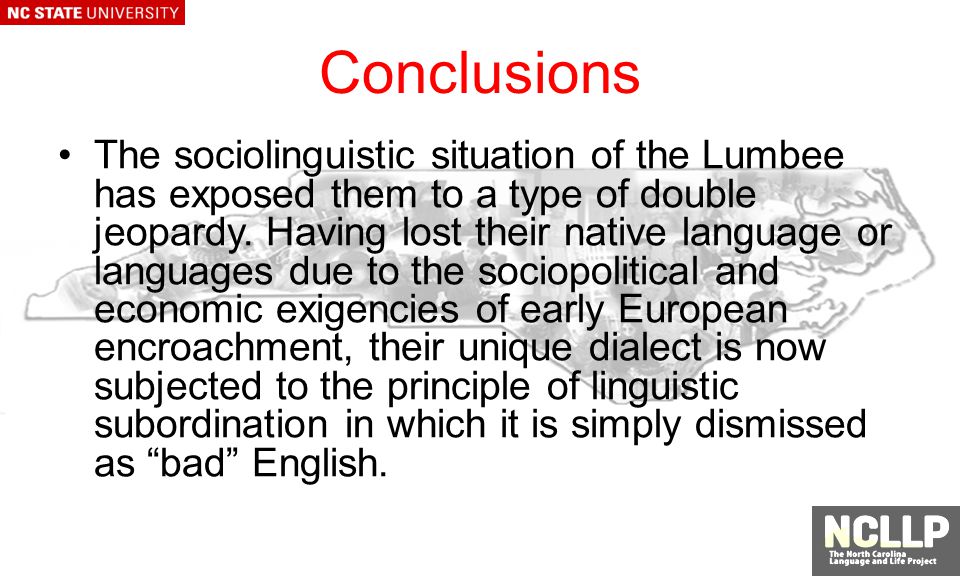
http://slideplayer.com/slide/1641706/
The above image is a screenshot of a slide from a presentation concerning Lumbee English. It effectively summarizes the chronic misunderstandings that the Lumbee population deals with daily. The ridicule bestowed upon the Lumbee people seems to stem from the uniqueness of their dialect. Lumbee English is divergent from mainstream U.S. English in terms of pronunciation, grammar, and vocabulary.  For example, a member of the Lumbee tribe might say, "It bes really crowded." So, "be(s)" is often utilized in Lumbee English as a term similar to standard English's "is." Similarly, the use of "I'm" is altogether different in Lumbee English. One who uses the Lumbee English dialect might say, "I'm told you all that I know." This is recognizable as the Lumbee equivalent to "I've told you all that I know." In terms of pronunciation, the Lumbee dialect sounds somewhat like a cross between African American English and Southern U.S. English. However, there are a few distinct features of Lumbee English pronunciation that separate it from other local dialects. A "high" tide might be called a "hoi" tide according to Lumbee English. Such pronunciation harkens back to the influence of the British, the Highland Scots, and the Scots-Irish upon the Lumbee dialect. Also, the Lumbee people employ certain terms that are not widely known by those who speak standard American English. The term "júvimber," for example, refers to a sling shot. Similarly, the term "mommuck" is a verb that refers to messing something up. "Weren't" is also commonly used within the Lumbee community. A Lumbee person might say, "It weren't me." So, "weren't" seems to be interchangeable with "wasn't." 

These differences, although relatively slight, have alienated the Lumbee people as a tribe without a true identity. The Lumbee do not have their own unique indigenous language. Furthermore, their use of English is generally considered improper by those who promote mainstream U.S. English. This catch-22 situation makes the Lumbee population an altogether unique group. They are, of course, an authentic culture, and those who would deny the Lumbee of their indigenous history are simply unreasonable. 

Thursday, November 17, 2016

Barstool Sports: Playing by Their Own Rules for Success

I. Introduction


               If you’re reading this blog post, chances are you read the last one, checked out Barstool, and now are back to learn more about these sports swamis and what they are doing for the progression of the English language.  (Or you’re Dr. Estes—more likely the latter.)  As we learned last post, the writers at Barstool have growing their loyal fan base exponentially and are competing with some of the titans in the sports commentating world such as ESPN.  How are these quintessential “David” men competing with the “Goliath”?  It’s basically because these sports bloggers are more than just that, they are social commentators on everything important to a stereotypical testosterone-pumping male—including, but not limited to, girls, beer and debauchery. And if you’re wondering why this is working you’re in luck, because not only are we going to discuss this impact they have had, but we will do it thoroughly and pinpoint some scholarly theories as to why these guys are so successful.
Introduction: Barstool is Formed
                Dave Portnoy, founder of Barstool Sports and better known by his cult-like following of young males as “Pres” or “El Presidente,” launched his website in the metropolitan Boston area, at first only writing about gambling advice or fantasy football tips.  However, as the site’s popularity grew, their content expanded into blogs about all sports, and from there—anything they wanted.  According to entrepreneur.com, Portnoy wanted to make a sports site for the “common man,” and break away from the rules and regulations of everyday sports writing.  "Dave is hell-bent on proving everything in the mainstream wrong," Kevin Clancy, a writer for Barstool, says. "He wants to prove all the advertising agencies are wrong, all the media agencies are wrong and all the PR agencies are wrong. He is fighting against everyone who says you have to play by the same cookie-cutter rules, and he won't stop until he proves he's right. It's his crusade." 
                Barstool has expanded to having multiple Podcast radio shows, and have found their way to the actual athletes themselves, some world-class names, too.  Michael Phelps, Giants offensive lineman Justin Pugh and Mets pitcher Noah Syndergaard have all been seen sporting some Barstool “Saturdays are for the Boys” merchandise.  But how are these writers doing it? 

II. First Reason- Their Voice

David Portnoy of Barstool Sports
Dave Portnoy: Founder of Barstool Sports
Photo Courtesy of entrepreneur.com

                When you think of the major sports content producer SportsCenter, what do you think of?  Men and women gathered around a nice studio in suits and pencil skirts, laying out the details of that day’s athletic events.  Their writing is mostly dry, factual, serving the main purpose of getting the message across to their viewers as clearly and efficiently as possible. 
                As we’ve learned, this is NOT the image Portnoy and his staff want to embody when people think of Barstool.  They want you to think beer-stained Ralph Lauren button downs that are missing buttons from a night of long partying.  Worn-out Sperry boat shoes that have seen not boats, but too many dirty, sticky barroom floors covered in stale alcohol and washed away vomit.  And the lack of formality in their writing has gotten them that reputation.
                According to James E. Katz and Chih-Hui Lai in their article, “News Blogging in Cross-Cultural Contexts: A report on the Struggle for Voice,” citizen journalists and political bloggers also have to consider voice in their writing to maintain an audience.  Katz and Lai write, “Unless the mainstream media are able to successfully incorporate the more localized concerns—concerns that have been overshadowed to some degree up by the development of mass media in the nineteenth and twentieth centuries—they are likely to lose their audience.” (105).  Portnoy and the writers at Barstool have taken on a similar concept.  They have found their niche audience of makes 18-35 and have created a voice that would suit those readers.  And in doing this, they write articles about things they know these people want to hear: some examples being their infamous “Smokeshow of the day,” where they post a picture of an attractive woman to the site with a background about who she is, and have even gotten as vain as “Guess That Ass,” where readers must guess the derrière of a famous female by only seeing a picture of their lower bodies.
                This tone, style and content has angered a lot of people, mostly feminists who claim Barstool’s writing is misogynistic and offensive towards women—which it undoubtedly is.  Even radio host Howard Stern has voiced some grievances with the site, and he himself in known for being crude.  However, Portnoy does not care about the “haters.”  Portnoy said about Barstool’s content, “We're not trying to gain new readers by being crazy-outrageous. Our readers get what we do, and I don't think about what it's going to look like to the outside world. I don't really care."  Which will bring us smoothly to our next topic as to why Barstool is so successful, their readers.

III.  Stoolies—The Catalyst Behind Barstool’s Success

Image result for barstool blog\
Barstool's infamous logo
Photo courtesy of aol.com

                Ah, yes—the Stoolies.  A rowdy bunch who find solace in sports, drinking, gambling, women, but most of all—they find solace in Barstool.  By pinpointing his audience and perfecting the voice of the site, Portnoy has developed a loyal following.  A following to the point that Barstool has become more than just a website, but a community.
                Everybody wants to be noticed.  Whether that be as intelligent, funny, caring—we all want recognition, especially from people who hold high importance in our lives.  Dave Portnoy and his staff at Barstool understand that.  Therefore, they are not afraid to interact with their readers.  Whether that be on the site or in the street, (there was once an article written by Clancy about how he saw a Stoolie on an airplane and the reader didn’t say anything to him, to which he was offended,) these guys take the time out to let their readers know that they do matter, and the readers do the same.
                However, this does not happen as conventionally as a “nice article!” or “good reporting!” comment in the comments section.  You must remember, these are mostly “Bros,” and going along with the tone of the writing, the comments are going to be written in the same kind of register.  For example, a Barstool writer could pen an article entirely about Tom Brady’s wife, Gisele, and mention in one line, one quip, about something that reminded him of a time when he had sex.  No matter how well-written the article is, there will be a chorus of Stoolies in the comments section writing, “congrats on the sex.”  This is a language that all Stoolies speak in, the language of young men that will never give you the respect you deserve.  But it’s become their theme, their own language that bounces back and forth between the readers and writers.
                I-Ping Chiang, Yi-Hsuan Chiang and Yu-Chi Lin discuss in their article, “The Antecedents and Consequences of Blogging Behavior,” the importance of bloggers interacting with their readers and what blogs readers are more likely to comment on.  In the article, they state, “Based on our findings people prefer to leave messages and make recommendations about sites that are within their realm of interest, such as the blogs of friends or people with similar interests.” (316).  They also found that interactive feedback was influential on the participating bloggers in their study in terms of social and informational reward.  These findings are essential to the Barstool blog success.

IV Conclusion


                Dave Portnoy and his band of cronies are running their blog exactly the way they want to.  Their personalized voice and connection with their audience of readers are fueling the fire of their success, even when challenged by powerhouse mainstream sites.  Barstool is anything but a part of the mainstream, but with their recent exponential success, they are belching and beer-ponging their way into it.

References:

Chiang, I-Ping; Chiang, Yi-Hsuan; Lin, Yu-Chi. “The Antecedents and Consequences of Blogging Behavior.” Social Behavior & Personality: an international journal, vol. 41, issue 2, 2013, pp. 311-317.

Katz, James; Lai, Chih-Hui. “News Blogging in Cross-Cultural Contexts: A Report on the Struggle for Voice.” Knowledge, Technology and Policy, vol. 22, issue 2, 2009, pp. 95-107.

Ankeny, Jason. “The Man Behind the ‘Bible of Bro Culture.’” Entrepreneur. November 17, 2016. Entrepreneur.com.