Wednesday, March 25, 2020

The Cultural Identity Associated with African American English


American hip hop group OutKast uses African American English in their song “Elevators” to emphasize the cultural identity associated with AAE.


African American English (AAE) has a rich history of development, though scholars cannot seem to agree on its origin. Its features can be connected to English, West African languages, and some Caribbean Creole English varieties. Despite the disagreement on its origins, one idea remains clear: AAE follows its own system of rules, categorizing it as an English dialect with its own cultural identity.


There are features of AAE that OutKast uses in their song lyrics. John Rickford discusses elements like changes in pronunciation of th, deletion of final consonant sounds, and dropping b, d, and g at the front of auxiliary verbs. He also recognizes the use of invariant be, as in “we be goin to work every night”in cases of habitual action. 


In “Elevators”, for example, OutKast writes: “Now, everyday we look up at the ceilin' / Watchin' ceilin' fans go around tryin' ta catch that feelin'”demonstrating a deleted ending consonant g.

These AAE rules highlight its role as a dialect rather than the view that it is an incorrect, uneducated manner of speaking. In the cartoon below, this inaccurate assumption is demonstrated by a woman attempting to teach "proper English" instead of AAE.


Despite the rules that speakers of AAE follow, its use varies across the United States, creating regional differences in pronunciation and spelling. Many successful hip hop artists were from the east or west coasts while OutKast originated in the south, making their use of language significant to their identity. Taylor Jones determines the four main regional boundaries of the dialect in his study on AAE use across Twitter. The northeast, south, west, and the expanse of land between former slave states and the Northern cities Chicago, Detroit and Cleveland are the regions Jones emphasizes with their own spellings and slang terms.

The regional dialect distinctions highlight OutKast’s unique identity.
Howard Rambsy claims that Andre 3000, one member of OutKast, demonstrates control over AAE and the culture associated with the dialect through his language. He even wrote lyrics, such as in “Elevators”, that refer to African American politics and their struggles at the time he was writing. This use of dialect helped OutKast succeed in the hip hop world despite their southern origins.

OutKast’s lyrics seem to push negative perceptions of AAE out to foster a more accepting culture surrounding southern blackness. Their use of regional language helps them show that AAE is not used only by lower classes. Cecelia Cutler argues how all listeners are submerged in AAE by listening to hip hop, helping them more fully understand that it is a proper dialect used by many speakers. In this way, OutKast is participating in the AAE conversation, recognizing its cultural importance.

While AAE’s origins are widely contested, the cultural identity it supports is undoubted. It is up to the non-AAE speaking public to recognize its role and accept its place in language.

Spanglish Influence in Pop Music


Spanglish music is making its mark on modern day society through the pop music industry. It is hard to listen to the radio today without hearing lyrics sung in Spanish. Singers like Shakira, Pitbull, and Enrique Inglesias have paved the way for many other hispanic artists to create art that is true and authentic to who they are. This Latin influence in music has resulted in a myriad of hit Spanglish songs like “Hips Don’t Lie,” “Despacito,” “Mi Gente,” and “Contigo.” Through different practices like code-switching, many hispanic artists are able to create songs that appeal to both English and Spanish speaking fans nationwide. 

Spanglish, while it is not its own language, is most often spoken in places with large Latino populations like Puerto Rico and Southern California. These are often noted as the “Spanglish hotbeds.” There are no specific grammar rules or lists of vocabulary words specifically unique to Spanglish, it is instead it is a hybrid of both English and Spanish. While it is typically spoken by people who are fluent in both languages, it is more than just an effect of being bilingual. 

One of the most notable features of Spanglish is code-switching. Code-switching allows speakers to use English and Spanish words interchangeably, keeping the structure of the respective language throughout a conversation.  Shakira’s hit song, “Hips Don’t Lie” has multiple examples of this phenomenon. A perfect example of this is the phrase “don’t you see baby así es perfecto.” While the line starts off in English, it changes to Spanish at the end, resulting in Spanglish. 
The success of songs like this have had an influence on the current popular music industry. Songs like “Despacito” topped the Billboard Hot 100s charts for an astounding 44 weeks in 2017. This proves that Spanglish was not a fad, and that people around the world are connecting with it. 
Jennifer Lopez and Shakira on stage at NFL Super Bowl LIV
As seen in the image above, blobal superstars Jennifer Lopez and Shakira performed together during the halftime show of the NFL’s Super Bowl LIV. These are two women who helped to build the demand for Latin pop in the US mainstream, so them  teaming up created quite the moment. They performed a number of  their greatest hits, many of which featured Spanglish lyrics. Two artists whom Lopez and Shakira paved the way for in the industry, J Balvin and Bad Bunny, were brought up to join them on stage in their performance. In addition to the music, these performers included more cultural rituals through dance. By remaining authentic and true to their roots, Shakira and Lopez are showing how the US is constantly evolving and expanding on their cultural acceptance and inclusion. 

While Spanglish today can be seen across different forms of media including advertisements, TV shows, musicals, and songs, this was not always the case. People used to look down upon Spanglish and view it as an underground form of communication.  In 1999, Latino/a artists used have to produce English-only songs in order to attain commercial success in the US. This is not the case for artists in 2020. The US has shown a great deal of cultural acceptance and empowerment. Diversity in music is encouraged today and there are many predominantly Spanish songs that top the charts in pop music.  Music has really helped bridge the gap between Spanish and English and encourage the use of Spanglish in the modern world. 

Tuesday, March 24, 2020

The Importance of AAE Research Through Zora Neale Hurston's Novel Preparation


Zora Neale Hurston’s
Their Eyes Were Watching God reflects the in-depth research that Hurston had done to form a well-adapted representation of the African American English (AAE) dialect in Central Florida.

The importance of Hurston’s dialectical research reflects on the misrepresentation of dialects that teeter on the verge of racist or stereotypical. The history that revolves around Ebonics or AAE is often looked down upon as being a sign of being
uneducated or illiterate. Often the criticism is rooted in America's long, dark history of racism. However, Hurston develops her novel by examining, authenticating, and embracing the distinctive features of vocabulary, grammar, and pronunciation of Central Florida’s AAE dialect by immersing herself in the culture and having grown up in the area.

According to Barry Betsy, Hurston reportedly spent multiple years in Eatonville, Florida
collecting folklore from the residents while secretly identifying the dialectical nuances of their speech. This methodic practice enhanced the Central Florida AAE dialect without giving cause to the real nature of her research.

Hurston’s dialect reflects the standardized forms for AAE while touching on the variations that the Eatonville AAE dialect has. Rather than assuming that the dialect spoken in Central Florida uses the standardized “rules” of AAE, Hurston defies those standards by documenting and researching the town. As Manuela Coppola argues, she notes that Hurston includes the elements of speech, but also the
idioms, metaphors, and prominent variations in sentence structures.
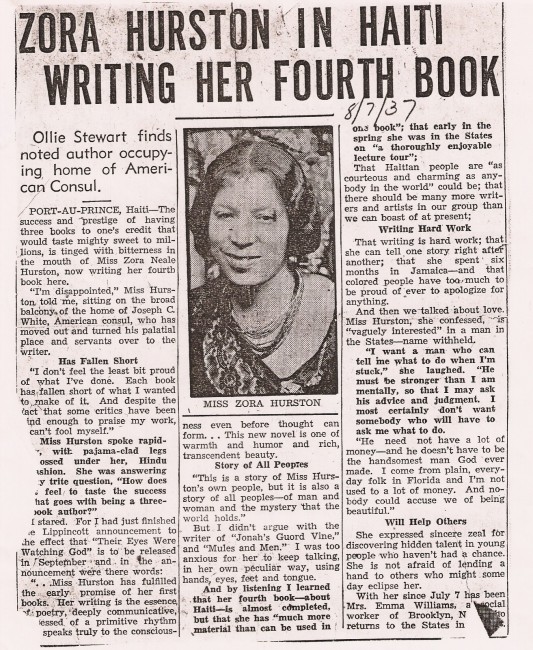
1937 News Article Documenting Hurston's New Anthropological Research


This news article reports on Hurston’s anthropological studies that she conducts prior to writing her novels. Her novel was
Tell My Horse: Voodoo and Life in Haiti and Jamaica (1938) and it was published one year following Their Eyes Were Watching God. Hurston wastes no time when it comes to research and writing, moving from project to project, using her skills as an anthropologist, and developing numerous books.

To fully develop a concrete, credible, and realistic study on language, it is important to immerse oneself into the culture to avoid using stereotypes or assumptions. In an article written by Tracey Weldon, she cites research by Baugh (1983) that encourages linguistic researchers to
study the communities of speakers who dwell in the area of research.

By immersing herself in the culture of the community she writes about, whether part of her fictional or nonfiction work, Hurston is developing a direct and true essence of the people. Having grown up in Eatonville, Florida and then later returning to the area for research, Hurston is working with two dimensions. A personal history with the town as well as the influences of other people in the community. To work solely from her own experience would not provide an accurate dialect because she would be working with only one person. In studying the community through the folklore, she not only gains a greater understanding for the AAE dialect in Eatonville, but also gains a sense of phrases, history, and tradition that adds flavor to the language.

The Rise of Spanglish in Popular Music

A plethora of interchangeable languages and dialects exist around the world, one of them being Spanglish. This hybrid language formed so English and Spanish speakers could communicate and understand each other. Before diving into Spanglish's contribution towards mass media, it is essential to understand what Spanglish is and how it came about.

Although the origin of Spanglish can be controversial, it has actually been around for centuries; some believe that Spanglish existed when the Treaty of Guadalupe Hidalgo was signed in 1848. After the signing, the United States gained a massive portion of Mexico. As a result, the two languages came together; Spanish speakers began to learn English and vice versa.

9 Memes Every Spanglish Speaker Can Relate To

In 2017, over 50 million people in the United States spoke Spanish; of those 50 million, a whopping 59% were bilingual. For those raised in bilingual households, Spanglish was a fun and easy approach towards communication.

As illustrated in the image above, Spanglish is known to include a feature known as code-switching, which is when a person shifts between two languages in a sentence. In this case, a person is alternating between English and Spanish, thus creating Spanglish. The above image, for example, starts in English, and by the end, shifts to Spanish. Although code-switching deems Spanglish certain qualities such as "cluttered" and "improper," it is of high importance; code-switching is an element with many functions, including but not limited to emphasizing more meaning through communication.

In today's society, Spanglish has remained a popular phenomenon. In recent times, Spanglish has taken over the music industry. If you have ever found yourself singing along to a song with a few Spanish lyrics and have no idea what they mean, congratulations - you interacted with Spanglish!

The Story Of... 'La Isla Bonita' by Madonna

In 1987, Madonna released her hit song "La Isla Bonita." The Latin-inspired song was dedicated to the diversity she experienced living in New York. Madonna admired the culture and beauty of Latin America and their people so much that it led to one of her greatest tracks. Though the majority of the song is sung in English, there are Spanish lyrics that fit well with the Latin-influenced rhythm. For starters, the title of the song is Spanish and translates to "The Beautiful Island." In the second verse, Madonna sings "Warm wind carried on the sea, he called to me / Te dijo te amo." The integration of Spanish for the phrase "he said I love you" is much more creative and holds more of a romantic tone than it would have in English. Moreover, in the bridge Madonna belts "When it's time for siesta, you can watch them go by." The majority of the lyric is expressed in English, but the use of "siesta" illustrates the code-switch.

The impact Spanglish has had on the media is incredible, especially for popular music. Several artists today are adding Spanish into their lyrics to be more inclusive, such as Cardi B and Demi Lovato. Overall, the appreciation of Latin culture has seriously improved the music industry for the better.

Monday, March 23, 2020

The American Novelist and the African American English Dialect

"The Adventures of Huckleberry Finn" by Mark Twain stands out not only for its characters but for its "representation of African-American English (AAE)."


Twain's ability as an author has helped him to expand the limits of speech. He enabled the African-American language and rhetorical practices to play a major role in the story. Among all the features of AAE, the character Jim utilized each frequently. Linguists Ningrum and Rohman say that AAE has two basic parts: grammar and sound. In discourse, Twain embodied these elements.

Samuel Langhorne Clemens (Mark Twain was his pen name) was born in Florida, Missouri. He'd had a distinctive style of storytelling. The vocabulary was used to reflect the time and Twain aimed to praise the language. While it will remain contentious to some due to the degree of which it has represented AAE, the material is authentic.


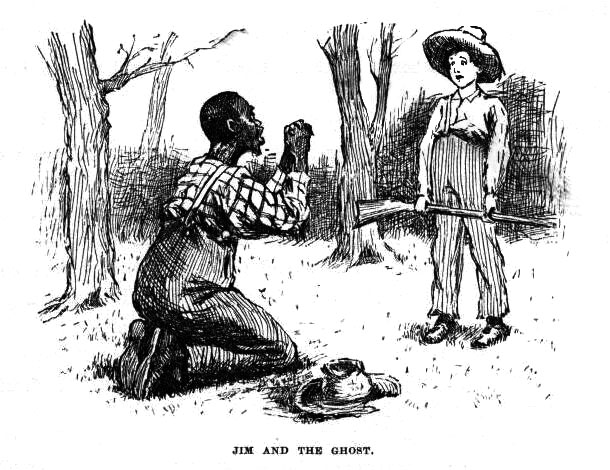
Twain's "The Adventures of Huckleberry Finn" has a range of AAE features. Jim's character encompasses the AAE dialect. AAE doesn't use have/has. On page 26, in the scene illustrated in the image above, Jim says “Don' hurt me—don’t! I ain't ever done no harm to a ghos," shows the stressed "done," to express an action as being complete. In this sentence, every word differs from Standard English, writes Ida Dewi.

The double negatives in "done no harm" are produced by applying negation to the action word and to the modifier of the noun, or to the object of the action word. There is another negative indicator, the utilization of "ain't" in the expression. To communicate this behavior, different dialects will use "haven't." This terminology is supplanted by AAE. Twain uses consonant clusters "Don' hurt me," when two consonants show up toward the end of a word and are reduced.

There is a strong respect for how Twain used Jim's character to speak to a natural dialect. Curt Rulan, a professor at Texas State University, notes that it does require the reader to note that Jim was a slave. The repeated use of AAE and given Jim's background was something that Twain made clear. With the discussion that this content has caused as far as it is taught in schools, it comes down to the reader and their capacity to take note of the important subjects, contrasting language, and sensitive topics. It is important to keep Mark Twain's writing of AAE around because it is a language and an important part of American history.

Despite the fact that Twain wrote the novel during the 1800s, AAE is a language that is utilized today. It shows that the idea of language is fluid and ever-evolving. Individuals need to quit seeing those who speak AAE as different, there is no standard in the English language. It relies upon what is said and is comprehended by the people who speak it. Twain may have composed something provocative, however, it aimed to paint an image of America, one that was brimming with varieties of English.

Tuesday, April 9, 2019

Spanglish In Pop Culture

     Throughout the world, there are a variety of languages and dialects that are used interchangeably with other languages and dialects; one of these examples is the use of Spanglish. The use of Spanglish can be dated back to the middle of the 19th century, when the US went to war with Mexico. Eventually Mexico surrendered and the Treaty of Guadalupe Hidalgo was signed. In result of this, Mexico lost half its territory to the United States, and the Mexican settlers that were already in the US automatically became citizens. This resulted in many more settlers into the US; with the Mexican settlers learning English, and the US settlers learning Spanish. 
     Spanish and English came crashing headlong into contact with one another, and this is what started Spanglish to take form. Spanglish is a hybrid language combining words and idioms from both Spanish and English. With 53 million Latinos living in the country, 59% of them are bilingual. It is a resourceful creation used by many Latino communities who share a bilingual and bicultural world. In many of these communities, residents may speak a range of languages that include formal and informal varieties of Spanish and English. Spanglish as well isn't exclusive to just the United States, but also to the rest of the Spanish speaking world as in other parts of the globe. There are also varieties of Spanglish - with using different patterns and forms. Spanglish is not a pidgin though - which is a grammatically simplified form of a language. As Spanglish can be the primary speech form for some individuals, there is a variety of Spanish with the heavy use of English.

     While Spanglish would appear to be messy and chaotic, it is the result of the linguistic process that are common in language contact situations that include borrowing, code mixing, and creating calques. One of the many forms and patterns that is very prevalent in Spanglish is Code-Switching. This occurs when a Spanglish user alternates in a single sentence between Spanish and English. This is an automatic and simultaneous translation, where Spanglish users might use Spanish words exclusively, but follows an English-language mode. The use of this code-switching is generally for bilingual speakers sometimes to switch between two languages in order to sustain their interaction when there is a loss for words. The mixing of Spanish and English can occur at the word, clause, or sentence level. It can be used to gap in the vocabulary, lack of education, improper control of language, and the overall lack of proficiency in one or both of the languages. 
          Spanglish is still thriving in today's world. While there is much criticism about the use of Spanglish as a language, the younger generation especially have appropriated Spanglish as a positive signifier to refer to one of the communities innovative ways of speaking and communicating. This is shown as their becomes a major presence in Latin music. Latin music, with modern artists like
Pitbull, Prince Royce, and Enrique Iglesias, has become such a strong factor in the Spanglish community. Enrique Iglesias came out in 2014 with his popular song "Bailando", originally in Spanish and then coming out shortly afterwards with an English version, that includes the sort of Spanglish text. During the chorus, he sings "I wanna be contigo / And live contigo, and dance contigo". While he is using English for the primary portion of the song, he also adds the Spanish word "contigo" in this small section to find a word that fits the Spanish portion. 

How Did "Bailando" Become A Spanglish Crossover Hit?


     Spanglish has transitioned to such popularity throughout the past century, and it has integrated itself into popular culture that people that might not know Spanish, would try and sing along to the songs or at least appreciate the art that artists create. It has become so integrated into society, that it has become such a significant aspect of American culture. 

Culture Teaches Language: African American English

        One of the main differences between African American English or Vernacular and any other dialect of the English language is that there’s a deep history within the usage of language and why it is used in the manner that it is.  The dialect itself, is complex for multiple reasons, and one being that the dialect doesn’t have a geographical boundary, but is inclusive of mostly Southern and Western regions of the U.S.  In addition, many terms have been utilized in order to refer to African American English, such as Ebonicsas well as encompass different ethnic categorizations that all are tied back to this dialect.  This is directly related to the linguistic system itself, in the sense that it is the result of an outgrowing of European languages and West African languages that were combined during the times of slavery. Elements such as social class, degree of segregation among people, etc. cause the creation of words that aren’t necessarily seen in different areas of the country, but are present in other’s. What is meant by this is that specific social situations that effect the dialect’s development, consist of densely populated areas that share in the same dialect, and aren’t extensively exposed to other dialects or intrusion of their community by people that practice a different dialect.  Continuing from that, African American English in a sense has been developed as a way for those that practice it, to distinguish themselves from speakers of other English dialects.  Many children are incorporating these dialectal practices into their speech before they even begin schooling at age 5. 
'African American English' differences from 'Standard English' practices


Many of the examples seen within the chart above are relevant particularly to the dialect’s growth culturally as opposed to growth in an educational setting, although often times the dialect is attempted to be brought to the classroom by educators.  The linguistic construct that is African American English is extensive because it is expressed in cultural elements such as music, particularly in the work from the artist Tupac Shakur.  Shakur, born Lesane Parish Crooks in Harlem, New York, became a hip hop icon and esteemed writer before his untimely death in 1996.  Having lived the majority of his life in Los Angeles, California, this echoed in his writing and musical work especially showcased in the song titled, “Keep Ya Head Up.”  Not only is the music produced by Tupac inclusive of African American English vocabulary such as, ‘holla’, ‘ain’t’, and ‘be real’, but also proclaims phrases like, ‘And I ain’t tryna gas ya up’ and ‘2Pac cares if don’t nobody else care.’  This musical example of African American English is practical because it is an idolized form of the dialect that is still listened to today, while including structural and vocabulary elements repeated today.  Although there is no way to study the entire expansiveness of African American English, scholars have concluded that many similar characteristics and features appear in the speech and literature of African Americans throughout the United States.